
Do you know how well your eCommerce site ranks on Google? Ever wondered what your competition are doing to outrank you?
In this article I’ll look at why you should improve your organic search performance, and some tricks that can help you do it.
Why worry about organic search performance?
The truth is that for most sites, strong search performance and a high-quality user experience are the same thing. Your users want to land on a page that’s easy to use, well-written and helps them to do whatever they want to do. Google’s aim is to send them to the website best able to give them what they want. Your aim is to be the site that Google prefers to send those users to, so they can buy your product.
How Google assesses your website
This breaks down to four key points:
- Your site’s technical performance
- How your users behave
- Correct use of structure and high-quality backlinks
- Well-written content
How to look at your website’s technical performance (for free)
Getting insight into your website’s performance often comes at a premium, so the good news here is that Google offers a free way to check on technical SEO essentials like page loading speed and cumulative layout shifts (CLS). If you’ve ever noticed the text that’s in front of you being pushed down the page as a header image loads, that’s an example of CLS.
The bad news is that fixing the issues it flags usually requires having a good developer on tap. You probably know what’s coming next – we can help with that.
Here’s the link to the Google PageSpeed Insights tool: https://pagespeed.web.dev/
Finding out how your users use your website
There are multiple layers to this, and again, you can get some of the information you need for free, provided you have Google Analytics setup on your site. If you don’t already have it, put it at the top of your to-do list – it offers essential insight, and the only cost would be if you need a developer to implement it. Google offers lots of guidance on how to do it, although as it increases in complexity as a tool it has become a lot more technically demanding.
Google Analytics offers tons of information about how your users are behaving on your site, and can help you understand how long they stay on your site, and how many pages they look at while they’re there. It also offers some basic tracking of scroll depth, which is how far they move down the page – if they never get past the bit they land on, don’t visit other pages and leave immediately, that’s all going to be used against your site when Google decides how it should rank.
How should you structure a webpage?
While there’s not a precise format to building a good web page, there are definitely some best practices to follow. Some of them might not seem linked to SEO, but it’s really all self-supporting – do a great job of selling your page and you’ll get more visitors as a result, which then improves the page’s rank.
Firstly, use the Meta Description to sell your page. The Meta Description is the little precis that appears next to your page name in Google Search, like this:
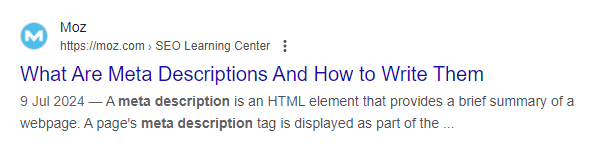
All websites will allow you to write your own for your pages, although the method will be different for each.
Next, make use of the different header options. Most sites will offer Headers 1-5 as standard (usually referred to as H#, e.g. H1), some may have more. These offer two benefits. They tell Google’s search robots how important the different headlines are when deciding to rank your page. H1 means it’s the most important header on the page, and all other headers should be considered as less important, but still more important than the copy that makes up the rest of the page.
You don’t have to use all of them, and the ones you don’t use don’t have to be in order – just remember that the highest number will be the most important.
They also act as a visual cue for your visitors – the biggest headline is the most important, but you’re drawing attention to all the important topics in your article.
Why do you need backlinks?
The rule for backlinks is that higher profile (reputable) sites have better quality links – the fact that they’ve linked to you is seen as a kind of endorsement by Google, and as a result you get improved ranking for your own pages. This works in reverse, too – lots of links from low-quality sites will make your site’s performance worse.
For most sites, it’s a balancing act. There are steps you can take to stop the bad links from being counted, but building your collection of good links can be a challenge. Have a think about any connections you might have that can help, which might be clients, industry connections or accrediting bodies.
The secret to well-written content
This one is much tougher to quantify, but sits across all the other factors. A well-written site will be more appealing to customers and Google’s search robots. It also increases your chances of taking one of the search features that will give your organic search performance a boost by featuring some of your content at the top of the page.
Copywriting is definitely more art than science, so if it’s not your forte then it might be worth looking at outsourcing it. There are also tools that will help with the basics, like Grammarly – it won’t write the copy for you, but it will help make it more readable.
The weapon of last resort here is of course GPT. Catapulting from being virtually unheard of to being the subject of at least 50% of the articles in my news feed at any one time, used the right way, GPT can be incredibly helpful with content creation. The vital thing is to remember that it’s only part of the puzzle – it’s not taken long for people to recognise the distinctive style of content written by GPT, so it should only be part of the process. Use it for research and content ideas, but not to produce anything that’s used without serious finessing from you or your team.
Ask for help if you need it
It’s easy to fall into the trap of trying to do everything yourself, but the fact is, agencies like ours exist because this work is difficult, technically finicky and really intensive. If you’re hitting brick walls everywhere you turn, give us a ring or drop us an email. We can quote for any or all of the work you’re struggling with, and in the long term finding a quicker resolution could well end up saving you money.
If your website isn’t delivering the results you were hoping for or expecting, it’s probably time to look at your search optimisation, sometimes also called your organic search performance (so called because it happens “naturally”, as opposed to paid search results that have a direct cost). In this Blog, we’ll look at what search engine optimisation is, what it does, and the foundational approaches to carrying it out.
What is Search Engine Optimisation (SEO)?
To really understand what SEO is, it’s helpful to know a little bit about how search engines worked before Google, and how they (Google) work now.
Back in the old days, when dinosaurs roamed the web, search engines were dumb. They didn’t know anything about you other than the words you were typing into your search bar, and they used a basic matching system to deliver you search results linked to the words. If you looked for “computer mouse”, you’d get some results about computer mice, some results about mice that eat cheese, and some results about computers but no mention of mice. You could find what you wanted with a bit of work, but the internet was a smaller place generally so there wasn’t a ton of results to wade through for most topics, and it was possible to get your page to the top of a search engine results page (SERP) using tactics as ingenious as including the word you were targeting as many times as possible in the page.
That all changed when Google came along. Google’s search results are affected by so many different factors that it’s not practical to list them all here, but here is a very rough explanation using some of the factors:
- Google’s search robots (bots) analyse (or crawl) every single page on the internet that they can reach
- The data collected by Google’s bots is used to assign every website a “quality” score based on Google’s own criteria
- The technical standard of each website is assessed, including how long a page takes to load
- The bots will also attempt to understand what the page is about in order to decide where it should appear in your search results
- Google hold data on everyone who has a Google account (in 2023 there were 1.8 billion users of Gmail, Google’s email software, worldwide)
- By combining their data on the page and their data on you and your behaviour, Google will then show you the search result it thinks best matches what you were looking for
As I say, this isn’t an exact explanation, but if we apply it to the same search as above, you can see the difference in the results.
If you look for “computer mouse”, Google knows that kind of mouse isn’t related to the animal, because it understands how the words work together to create context. It also knows that when you search for those words you’re looking for the answer to a question, and it wants to guess what your question is and answer you in the most efficient way it can. Your search might include a map which shows the nearest places to your location that sells computer mice, especially if you’re using your mobile phone to search. You might be preferentially served results for a site that sells computer equipment that Google knows you’ve previously visited. You’ll almost certainly get results that are adverts for places near you or online that sell computer equipment. Those are a topic for another day – we’re looking for the results that appear below those, which could include local search results, and features that highlight content from particular sites which answer the question Google thinks you’re asking.
And that’s where SEO comes in. It’s the art of structuring your website, including everything that’s written on it, to have Google understand what it is you do and how you can help its users, so that it can then recommend you to them ahead of your competitors.
How do we know what Google is looking for when ranking a webpage?
Because Google has done such a good job of keeping the algorithm that powers their search a secret, traditionally SEO has been based on observations of the way that pages perform.
That all changed earlier this year, when for the first time, Google’s internal documents were leaked that discussed some of the criteria that decide on the order of their search results.
That’s how we know that every site is given a quality score by Google, which was always suspected by industry experts, but never confirmed. We also know some of the other things that Google’s bots prefer to find when crawling a page.
Google’s stated preference for a site is that it demonstrates the qualities Experience, Expertise, Authoritativeness and Trustworthiness (Which they call E-E-A-T).
Experience means they want you to show that you’ve already done the thing you’re telling people you can do. Expertise is showing that you can do it well, and have good subject knowledge. Authoritativeness would ideally be demonstrated by having good quality links to your site from other sites in the same industry, or high-profile news sites like the BBC or The Guardian. Trustworthiness would look for reviews from Google itself, a third-party review site like Trustpilot, or hosted on your own site. On a more fundamental level, this one also wants your site to have secure hosting that protects the data of your customers.
So, what should you aim for?
- Informative, well-written content. This covers every single letter in the acronym, as it demonstrates why your goods or services are better than the competition (EE), the better your content the more sites will want to link to it (A), and if you’re hosting your own reviews from customers, you’ll want to work with them to make sure that they’re compelling (T).
- Content that’s been structured in a way that makes it easy for both people and Google’s search bots to read and understand it. Luckily, these two aims aren’t mutually exclusive.
- High-quality backlinks. Not much more to add here beyond what’s discussed above, but we’ll discuss the impact of low-quality backlinks later.
Creating quality content
One of the toughest parts of working on search optimisation is that it needs a combination of analytic and creative skills to address poor performance. It’s really easy to say that the solution is quality content, but what that looks like and how you produce it will be unique to everyone. To make it slightly easier, you can use the PARTY acronym:
Plan – Plan your content, not just by laying out the structure of your article, but by using tools like Answerthepublic, Google Trends, and the search suggestions in the Google search bar to look at what people are searching for, so you can answer their questions as part of your writing. It’s also helpful to produce a content plan which covers a longer period. This can be especially useful if you’re able to share the writing responsibilities, as it makes sure you’re all aiming at the same target.
Apply – One of the least sexy bits of search optimisation, and it’s not the sexiest job at the best of times, is the application of the fundamental aspects of optimisation. It’s discussed more below.
Research – As both a user and a search bot, there’s no worse kind of page to land on than one that’s thin on content. If you’re doing some writing and it’s not one of your specialist subjects, you need to do enough research to be informative, and if possible, find something new to add to the conversation.
Tell – Both the public and Google love a lived experience. If you’ve got personal anecdotes which relate to your topic, find a way to work them in there. If you have a house style for writing that doesn’t require you to be formal (which most retail businesses are unlikely to), adding some personality is a great way to make a connection with your reader.
Yield – Maybe this one should have been first, but no one is going to remember an acronym that spells out Ypart. What’s your article intended to do for your site? Do you want to promote a range of products, or demonstrate expertise in a particular area? This gives you the topic for the article, and that lets you know what to aim for with everything else you do.
Using the proper structure
This should go hand-in-hand with creating quality content, so much so that I’ve included it in the PARTY acronym. The key elements are:
Page title – the first thing people and bots see, and the keystone your search is built on. It can often be a good idea to make this a question that you answer in the article, to fit with the questions users are trying to answer via Google.
Headers – structure your paragraphs with compelling headers. Don’t be afraid to use questions here too, if they’re relevant to the topic. Headers use a simple bit of code (H1, H2, H3, etc) to tell Google the order of importance attached to your article headings. It also makes them larger than standard text (paragraph), which is important for your customers too.
Meta description – the precis that Google shows of your page’s topic. This is often a missed opportunity, don’t waste the chance to write something that makes your potential visitors want to learn more. Make the best use of the character limit (although the Google leak has shown that this isn’t all that important, it’s still good practice for the users who’ll be reading just the part that fits).
Build your backlinks
Strengthening your site’s search optimisation can sometimes be a case of who you know, rather than what you know, but with a bit of ingenuity you can create connections that will increase your search ranking and hopefully bring in a few more visitors directly.
High profile sites (news sites like the BBC, expert sites in your field of work, and some educational sites all have good quality authority that will flow through links into your site. Have a think about any connections you might have that could be interested in linking to you. If you don’t have any, that’s fine too, but it might take a bit more legwork to get a decent amount of links sorted out. If you’ve got something newsworthy, you should always include a link to your site from any press release you send out. It often won’t make it to the final draft, but if it does you’ll be getting even more use out of the story.
A quick word on toxic backlinks
So called “toxic” backlinks are ones that have the opposite effect on your site’s ranking. They might be from an attempt to boost a site’s profile in the early days of Google, when the number of links was more important than the quality, or they could have accumulated for an unknown reason. Whichever it is, there is a process to disavow the link via a Google tool if you aren’t in a position to have it removed from the other site (and many will not respond to contact emails), which can go a little way towards alleviating the problem.
Conclusion
This has been a very high-level look at the basics of Search Engine Optimisation. It can be intimidating to tackle without the right tools to measure success and suggest improvements, which is why we’re always ready to help if you need us. We’ve helped companies from a wide variety of industries to improve their site’s visibility, and would love to help you do the same.