Selling clothing online has always had a particular challenge for retailers: customers can’t experience before they buy, so your product images, reviews and information need to do the hard work.
A strong fashion eCommerce website now has to do more than ever before to convert a sale. It needs to, as much as it can, help customers understand how a garment looks, how it fits, what it feels like and whether it will work with the rest of their wardrobe, without them ever coming into contact with the item.
That supporting information is becoming ever more important as Google, social platforms and AI-powered shopping tools take a greater role in product discovery. Customers can increasingly search conversationally, compare products visually, generate shopping inspiration and virtually try on clothing before they reach a retailer’s website.
Some emerging systems can even help a customer complete a purchase without following a traditional journey through the retailer’s website through to checkout.
It’s taken the old playbook for clothing brand websites, set fire to it and then driven a lorry over it. That lorry is full of clothing that’s been sold by other websites already using this technology, making the important question how your brand can also get on board. The route to success used to be having the best static content, but you need to think about whether your eCommerce setup gives customers, search engines and emerging shopping platforms enough useful information to confidently find, recommend and sell your products in the strongest way possible – which might even be via a completely new channel.
Here are some of the most important ways that you, as a fashion retailer, can level up your eCommerce website.
Get ready for virtual try-on
Virtual try-on is moving beyond the novelty stage and becoming part of the way major technology platforms can help customers to shop for clothing.
Google initially developed virtual try-on experiences that allowed shoppers to see garments displayed on a selection of models with different body shapes and sizes, which was quite useful but pretty utilitarian as a feature. It has now expanded the technology so shoppers can upload their own photographs and visualise themselves wearing selected items.
Google launched its virtual apparel try-on feature in the UK in December 2025, allowing shoppers to upload a photograph and try on eligible products appearing across its Shopping Graph. The feature covers billions of apparel listings rather than being limited to products from a small group of participating retailers.
Google has also developed a more advanced process that can generate a reusable, full-body digital version of a shopper from a selfie and basic sizing information. The customer can then use this image when exploring products through Google Shopping.
This has the simultaneous impact of boosting the importance of your product photography (so Google has good data to build the preview with) and making its presence on your website less crucial than it’s ever been.
The better quality the photography, the more accurate the render will be, and that’s a powerful upgrade for the price of consistent imagery. The better quality the result, the easier it will be for consumers to imagine themselves in the garment, doing a proportion of the heavy lifting for you when it comes to sales. After all, if you’ve already seen yourself wearing it and looking good, what’s the remaining barrier to purchase?
You need to audit your main product images as a priority, and review whether you’re including shots that:
-
- show the full garment clearly and without obstruction;
- use consistent lighting and relatively uncluttered backgrounds;
- accurately represent the colour, texture and shape of the item;
- avoid excessive props, overlaid graphics or distracting styling;
- are large and detailed enough to be reused across different shopping platforms.
Lifestyle photography is still valuable, but it should complement clean, technically useful product images.
Retailers do not necessarily need to develop their own virtual fitting room. In many cases, the more immediate priority is ensuring that their images, product feeds and website data can support the virtual try-on experiences being created elsewhere.
What comes next? Video-based virtual try-on
Static virtual try-on isn’t the final stage of this technology.
Google Labs’ experimental Doppl app allows users to upload photographs of outfits found online, in shops or on social media and apply them to a digital version of themselves. It can then create a short AI-generated video showing the outfit being worn, giving the user a sense of how the overall look might appear in motion.
Doppl has also introduced a personalised, shoppable discovery feed in the US. It recommends outfits based on the user’s stated preferences and previous interactions, presents AI-generated videos of real products and links users through to merchants where the items can be purchased.
This remains an experimental product rather than a standard feature UK retailers can simply enable on their websites. However, it shows us where technology wants to end up.
Shopping platforms will eventually combine:
- personal style profiles
- product recommendations
- digital representations of the shopper
- AI-generated outfit videos
- direct links to purchasable products.
For retailers, that increases again the importance of maintaining a high-quality and consistent product media library. Images won’t just be used to illustrate an item, but will also help external systems generate entirely new ways of presenting it.
Make products discoverable from a description or an idea
Traditional fashion searches tend to be relatively short: “black midi dress”, “men’s linen shirt” or “wide-leg trousers”.
However, customers do not always begin with a recognised product term. They may have a particular item in mind but struggle to describe it using conventional retail categories.
Google’s Vision Match feature was developed for this kind of shopping journey. A user can describe an imagined item, such as a colourful midi dress with a large floral pattern. Google generates visual representations of that idea and then searches its Shopping Graph for real products with a similar appearance.
This introduces a different type of product discovery. Previously, retailers were looking to rank their products against traditionally descriptive search terms. Now, their products may be visually and semantically matched against a much more detailed customer brief.
A shopper could potentially describe:
A dark green fitted jacket with large gold buttons and a slightly military style. The system then needs to identify products that match the description, even if the retailer has never optimised a page for that exact combination of words.
To support this kind of discovery, product information needs to be specific. Useful attributes might include:
- the precise colour or shade
- pattern
- cut and silhouette
- length
- fabric
- fastening
- neckline
- sleeve style
- decorative details
- occasion
- season
- fit
Generic descriptions such as “a stylish addition to any wardrobe” won’t help a visual matching system. Describing the product accurately gives Google and other platforms more information with which to identify it. Clear product photography again plays an important role too, as the closer it is to the generated image, the greater the chance of your item being included in the recommendation.

Optimise for conversational shopping
The rise of AI-assisted search also means customers can ask much more detailed shopping questions. Voice search has been on the list of technologies to optimise for since at least 2019, but the rise of AI technology that can hold a conversation means that it is now growing in a completely different direction.
Instead of searching for “navy suit”, a customer might ask:
“Find me a lightweight navy trouser suit for a summer wedding, suitable for someone petite, which can be worn with flat shoes and delivered before Friday.”
Google’s AI shopping experiences are designed to interpret detailed prompts, consult product information in its Shopping Graph and allow the customer to refine the results conversationally.
This means parts of a product page that retailers may previously have treated as secondary can now help determine whether a product satisfies a complex request. These might include:
- whether the garment is suitable for a particular occasion
- the climate or season it suits
- the weight and feel of the fabric
- whether it works for petite, tall or plus-size customers
- whether it can be worn with particular footwear
- current delivery availability
- care requirements
- whether coordinating items are available
This is achievable by giving each item a complete, factual and distinctive description. Getting bogged down in the specifics of the myriad ways that someone might search for this information is just not a practical solution.
The aim is to make the product understandable even when the customer describes what they need in their own words rather than using the language chosen on your site.
Treat product data as part of the shopping experience
Most fashion websites naturally focus on what customers can see on the page. Increasingly, what sits behind that page matters just as much.
Google Merchant Centre, structured data, platform feeds and commerce APIs all help external services understand details such as:
- colour
- size
- price
- availability
- material
- gender
- age group
- brand
- product category
- delivery
- returns
- product identifiers
Google recommends sharing product information through both structured data and Merchant Centre feeds because this can improve its understanding of products and increase eligibility for different shopping experiences.
Incomplete or inconsistent product data can limit where a product appears and make it harder for search engines and AI shopping tools to match it with the right customer.
Make sure your feeds provide accurate information for every meaningful product attribute, including:
- brand and product title
- colour and pattern
- gender and age group
- material
- size and size system
- availability
- price and sale price
- condition
- product category
- Global Trade Item Number, where applicable
Avoid stuffing product titles with promotional phrases or filling descriptions with vague brand language.
A title such as “Women’s navy linen wide-leg trousers” provides more useful information than “The must-have trousers of the season”.
The clearer the data, the easier it is for Google and other discovery platforms to understand who the product is for and when it is relevant.
Structure product variants properly
A single item of clothing may be available in several colours and a dozen different sizes. From the customer’s point of view, these are variations of the same product. From the website’s point of view, however, they can easily become a confusing collection of URLs, stock records and product data.
Google supports ProductGroup and product variant structured data for products such as apparel and footwear that are sold in different sizes, colours, materials or patterns. This allows retailers to indicate that several individual variations belong to one broader product group.
Implementing this properly can help Google understand the relationship between variants rather than treating every size or colour as an entirely unrelated product.
It can also improve the customer experience. Shoppers should be able to move between colours and sizes without losing their place, encountering an unexpected page reload or discovering too late that their chosen combination is unavailable.
Your website should make it immediately clear:
- which colours and sizes are available
- which combinations are out of stock
- whether another variant is available
- whether an unavailable item can be ordered or reserved
- whether the customer can request a restock notification
The same information must remain consistent across the website, Merchant Centre and any other sales channels.
Variant management may sound like a technical detail, but poor implementation creates friction at one of the most commercially important points in the buying journey.
It can also make it harder for AI shopping systems to distinguish between a product that is completely unavailable and one that is simply out of stock in a particular size.
Make sizing genuinely useful
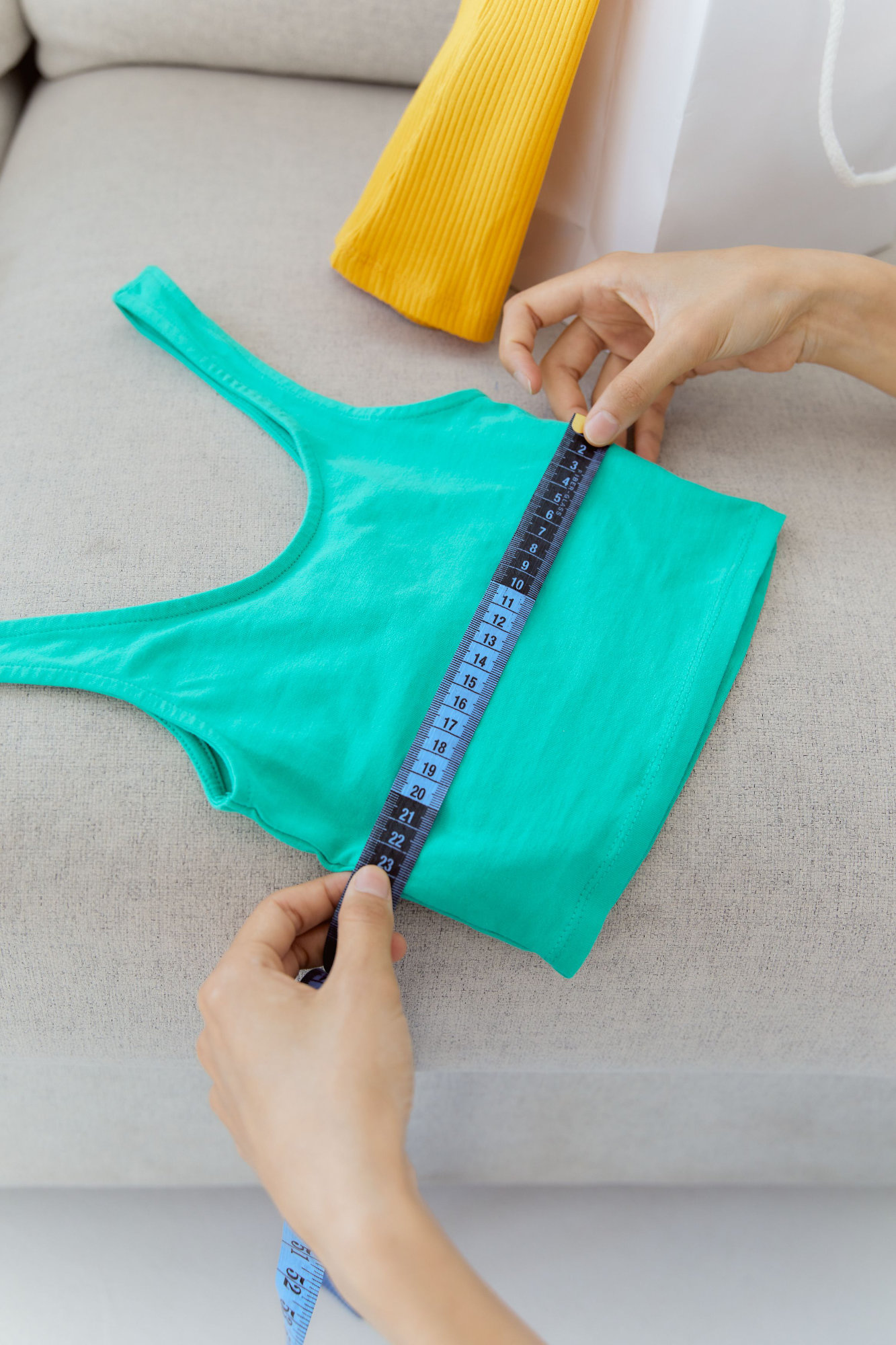
A generic sizing table is better than no guidance at all, but it’s not going to answer the customer’s real question of “Will this particular garment fit me?” without some work on their behalf.
Sizing can vary significantly between brands, product ranges and even two garments sold by the same retailer. A standard chart that simply converts UK sizes into chest, waist and hip measurements may not explain whether an item is intentionally oversized, tightly fitted, cropped or unusually long.
Competitive fashion websites provide guidance that is specific to the product, which might include:
- the model’s height and the size being worn
- whether the item runs small, large or true to size
- garment measurements as well as body measurements
- the length, rise or inside leg
- the level of stretch in the material
- fit notes based on verified customer feedback
- a size recommendation or fit questionnaire
This information should be easy to find close to the size selector. Hiding it in a general FAQ or placing it at the bottom of a long product description was a favoured SEO tactic for many years, but now that the information has more meaning, this placement means many customers will never see it.
Good sizing information can increase confidence before purchase. It may also help tackle one of the fashion sector’s most persistent commercial problems: customers ordering several sizes with the intention of returning most of them.
Virtual try-on may help customers visualise an item, but it doesn’t remove the need for accurate measurements and honest fit guidance.
Show more than the front of the garment
Customers need to inspect clothing in much greater detail than many other online products. One polished front-facing photograph was pushing your luck even before these technical advances, and now it’s a clear sign that you’re not taking your business seriously.
A useful product gallery should help the customer answer practical questions.
What does the back look like? How long is it? Is the material sheer? Does the fastening look secure? How does the fabric move? Are there pockets? What does the stitching look like close up?
Depending on the product, useful media may include:
- front, back and side views
- close-ups of fabric, seams, fastenings and details
- photographs of the item on more than one body type
- short video clips showing the garment in motion
- zoomable high-resolution images
- styling photographs showing how the item can be worn
- user-generated photographs from customers
As visual search and AI-generated shopping experiences develop, these assets may be reused outside the product page itself.
A strong product media library becomes a feature that supports both the immediate on-site shopping experience and the external platforms through which a customer may discover the item.
Consider reusable 3D product assets
Augmented reality and 3D product models are not new ideas, but the tools available to create and distribute them continue to improve.
Google’s merchant listing documentation allows retailers to provide 3D model information for eligible products, while social and commerce platforms have developed augmented-reality try-on and interactive 3D viewing experiences.
Creating a 3D model for every item on your website isn’t going to be viable. Picking a selection of items based on sales and page visits, however, is definitely worthwhile.
As a suggestion, it may be more valuable for products such as:
- footwear
- eyewear
- handbags
- jewellery and accessories
- high-value items
- permanent or frequently repeated product ranges
- flagship products used heavily in advertising
We’ve focused more on using these items on the website and within the wider Google ecosystem in this article so far, but it’s important not to overlook the other venues that they can help with – social media being the main example.
Build product pages that can answer questions
Search behaviour is becoming more conversational, but the product page remains one of the retailer’s most important sources of information.
It should not rely on imagery to communicate everything. Its written content should explain the characteristics that matter to a customer and distinguish the item from similar products.
Depending on the garment, this may include:
- cut and fit
- fabric composition
- weight and feel
- lining
- fastening
- pockets
- hem length
- sleeve style
- care requirements
- weather or seasonal suitability
- styling suggestions
- delivery and returns information
This means the description should provide specific information rather than interchangeable phrases such as “effortlessly stylish” or “perfect for every occasion”.
Clear product copy is useful to customers, conventional search engines and AI systems attempting to interpret or recommend the product.
A genuinely helpful product page should already answer the questions customers are likely to ask before they need to leave the page, open a live chat or search elsewhere.
Improve your merchant listing data
Product structured data can make a page eligible for enhanced appearances within Google Search, including product snippets, Google Images results and shopping-related listings.
Merchant listing markup can communicate information such as price, availability, shipping, returns, member pricing and product details directly to Google.
For fashion retailers, it is particularly important that the structured data on the website matches the product feed and the information visible to customers.
If the page says an item is available but the feed says it is out of stock, or the structured data contains a different price, Google may have difficulty deciding which information to trust.
Retailers should regularly test their product markup and monitor the Merchant listings and Product snippets reports in Google Search Console.
Errors should not be left to accumulate simply because the product pages still appear to function normally for customers.
Make returns and loyalty benefits machine-readable
Surfacing your returns policy and any membership benefits you offer is a strong trust signal even without a foundation of data, and Google now supports organisation-level return-policy structured data to allow the policies to be more easily read and understood. Retailers can provide information about matters such as the returns window, applicable countries, return methods and return fees through markup or relevant Google services.
It also supports loyalty-program structured data, which can communicate benefits such as member prices and loyalty points. Google may use this information alongside products and within other search features, creating many additional opportunities to convince prospective customers with your policies and offers.
Customers are often more hesitant to order clothing from an unfamiliar shop because they are uncertain about fit, and don’t want to fall victim to a punitive or unhelpful returns policy. A clear and competitive returns policy surfaced through easily parsed schema can influence the purchase before the customer visits the website.
Similarly, a members-only price or loyalty reward may help one your shop stand out when several similar products are being compared.
You should ensure that these policies are:
- clear to customers
- accurately represented in structured data
- consistent with Merchant Centre
- kept up to date when terms change
It is another example of the wider buying decision moving beyond the boundaries of a retailer’s product page.
Prepare to sell through AI agents
Perhaps the most significant development is the movement from AI-assisted product discovery towards AI-assisted purchasing.
Google has introduced agentic shopping tools that can track the price of a product according to the customer’s chosen size, colour and target price. In supported cases, its systems can help add the product to the retailer’s basket and complete the purchase using Google Pay after receiving the customer’s confirmation.
Shopify and Google have also co-developed the Universal Commerce Protocol, or UCP. It is designed to provide a common language through which AI agents and commerce platforms can handle stages of the shopping journey from discovery to checkout.
Shopify has begun enabling selected merchants to sell through Google’s AI Mode and Gemini, with wider agentic commerce capabilities being developed across other AI platforms.
Of course, customers won’t immediately stop visiting fashion websites. What this does suggest, however, is that future shopping journeys might not always follow the familiar route of:
- search result
- homepage
- category page
- product page
- basket
- checkout
An AI assistant can potentially help the customer define what they want, compare products, check availability and begin or complete the transaction through a connected shopping environment.
To participate reliably, your site will need more than attractive design. It needs:
- accurate live pricing
- reliable inventory information
- correctly structured variants
- current product images
- accessible delivery and returns details
- a stable checkout
- well-maintained feeds and integrations
The eCommerce website increasingly needs to operate as both a shopfront and a dependable source of commerce data.
Use AI to improve discovery, not replace merchandising
AI-powered search and recommendation tools can also improve the experience within your own website.
They can help interpret natural-language searches, suggest complementary items and adapt recommendations based on customer behaviour or stated preferences, which can be a significant upgrade if you’re currently running with generic search.
A customer might search for “Something smart but comfortable for an outdoor work event.”
A conventional keyword search will struggle if none of the individual products use that exact wording. A stronger search system can interpret the intended occasion and return relevant garments.
However, installing an AI recommendation or search app is not a substitute for organising your catalogue properly.
The underlying product relationships still need to make sense. Your site should define how products relate by:
- collection
- style
- occasion
- colour
- material
- season
- fit
- complementary items
A well-designed recommendation system might suggest the matching jacket, an alternative colour or an item with a similar fit.
A poorly configured one might just promote whatever has received the most clicks, regardless of whether it helps the customer.
Human input into merchandising remains important, and AI should strengthen it by making a larger catalogue easier to explore instead of producing an endless carousel of loosely connected products.
Connect content and commerce
Fashion purchases are often driven by inspiration as much as direct demand.
Customers might begin by looking for advice on what to wear to an event, how to style a particular shape or how to build a more versatile wardrobe.
Useful editorial content can bring these customers into the website earlier and then guide them towards relevant products.
Examples might include:
- what to wear to a summer wedding
- how to style wide-leg trousers
- a guide to different denim fits
- how to build a capsule wardrobe
- the best fabrics for travelling
- how to care for linen or cashmere
- how to choose a coat for your body shape
The commercial opportunity is lost when these guides are too separate from the shop.
Products should be linked naturally within the content, while product pages can link back to useful styling or care advice.
Shoppable lookbooks, editorial collection pages and “complete the outfit” features can narrow the gap between inspiration and purchase.
Identify the changes that solve real customer problems
Not every fashion retailer needs to launch a virtual fitting room, commission 3D models and install an AI assistant immediately.
The best place to begin is by identifying where customers are currently losing confidence or abandoning the journey.
- Are they struggling to choose a size?
- Are important product details missing?
- Do they frequently return items for the same reason?
- Are mobile users abandoning the basket?
- Are product variants being rejected by Google Merchant Center?
- Can customers find products by occasion, style or fit?
- Is the website’s product data consistent across every sales channel?
For many of our clients, the most valuable eCommerce improvements are usually the ones that solve a recognisable problem.
Your initial priorities are probably less dramatic than implementing cutting-edge tech. They may include:
- improving product photography;
- cleaning up the Merchant Centre feed;
- restructuring variants;
- adding more useful fit guidance;
- fixing mobile product pages;
- improving on-site search;
- implementing structured data;
- connecting editorial content with products
These changes improve the existing customer experience while also preparing your site for more visual, conversational and AI-assisted shopping journeys.
New technology can make online fashion shopping more visual, personal and convenient. But it will only deliver meaningful results when it is supported by accurate data, clear communication and a website that is easy to use.
We design, build and improve eCommerce websites around the needs of both retailers and their customers. From Shopify development and integrations to UX, conversion optimisation and product discovery, we can help you to create a shopping experience that is ready for the next generation of online retail.